




 1 Day
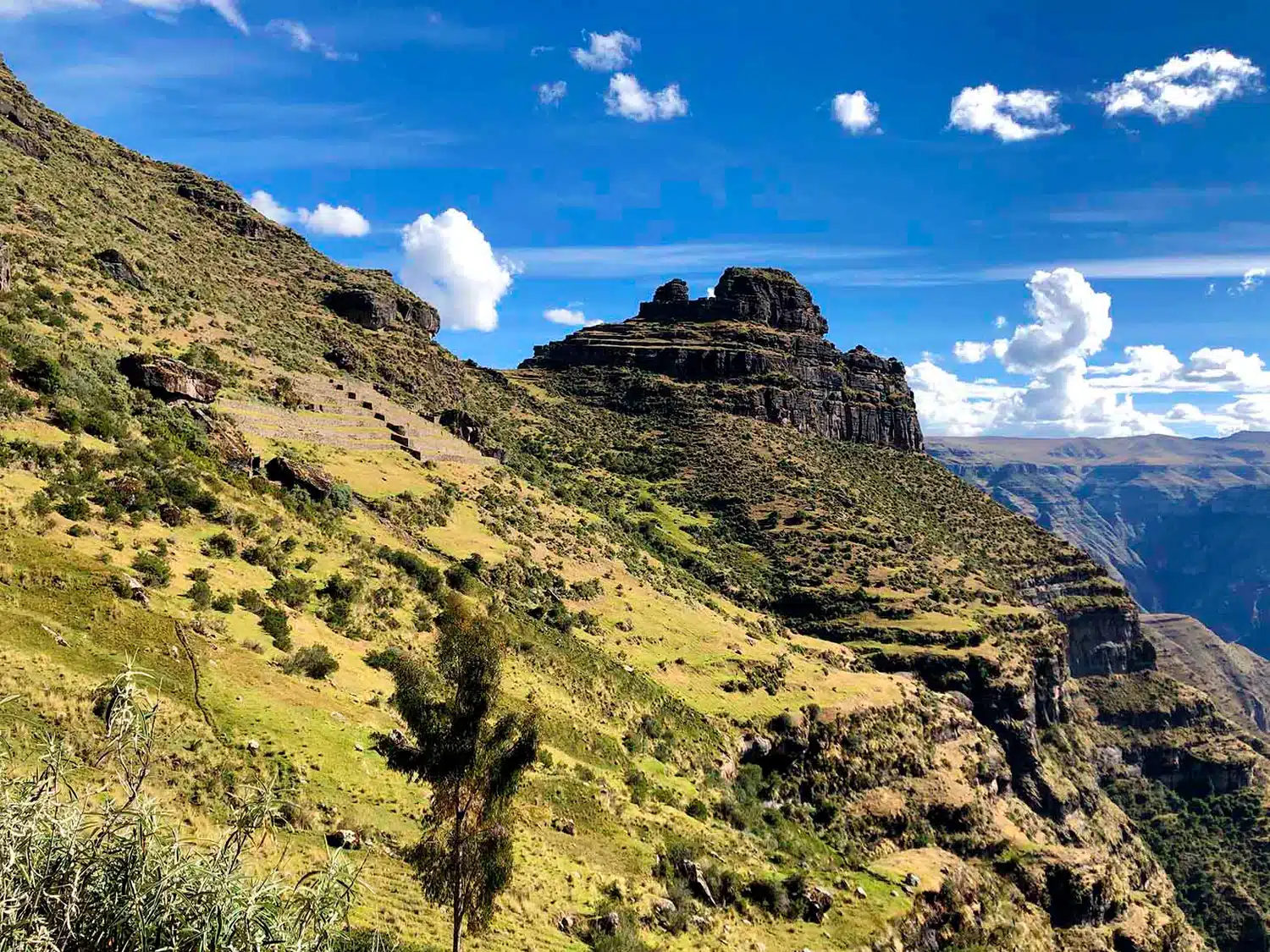
Waqrapukara the archaeological site is located in the District of Acos, Province of Acomayo, Department of Cusco. It is strategically located joining the Apurimac valley and the Pomacanchi plateau, it is a cultural landscape with cognitive elements of wisdom and power, where two rocky protuberances rise, with an architecture camouflaged with carved stones.
Adapted to the monument, walled with walls of semicircular containment, with stairways, trapezoidal windows and niches, enclosures, accesses to small spaces, a central plaza facing east with trapezoidal constructions with one, double and triple jambs, including a stone for ceremonies or “Waka” and a “Machay” or cave; All these elements are found at the foot of the rocky protuberances, whose architectural characteristics make us infer that this space was ceremonial and sacred and probably had other functions for its time.
This archaeological complex called Waqrapukara. According to researcher Dr. Victor Angles Vargas, etymologically it comes from two words, waqra means horn and the word pukara means fortress or barracks. In short, this word waqrapukara means fortress in the form of a horn. It was a residence of the nobility of this place; with astronomical observatories and at the same time it was a protected religious center with watchtowers and underground paths.
DAY 1:TOUR WAQRAPUKARA: CUSCO – ACOMAYO – WAQRAPUKARA – CUSCO
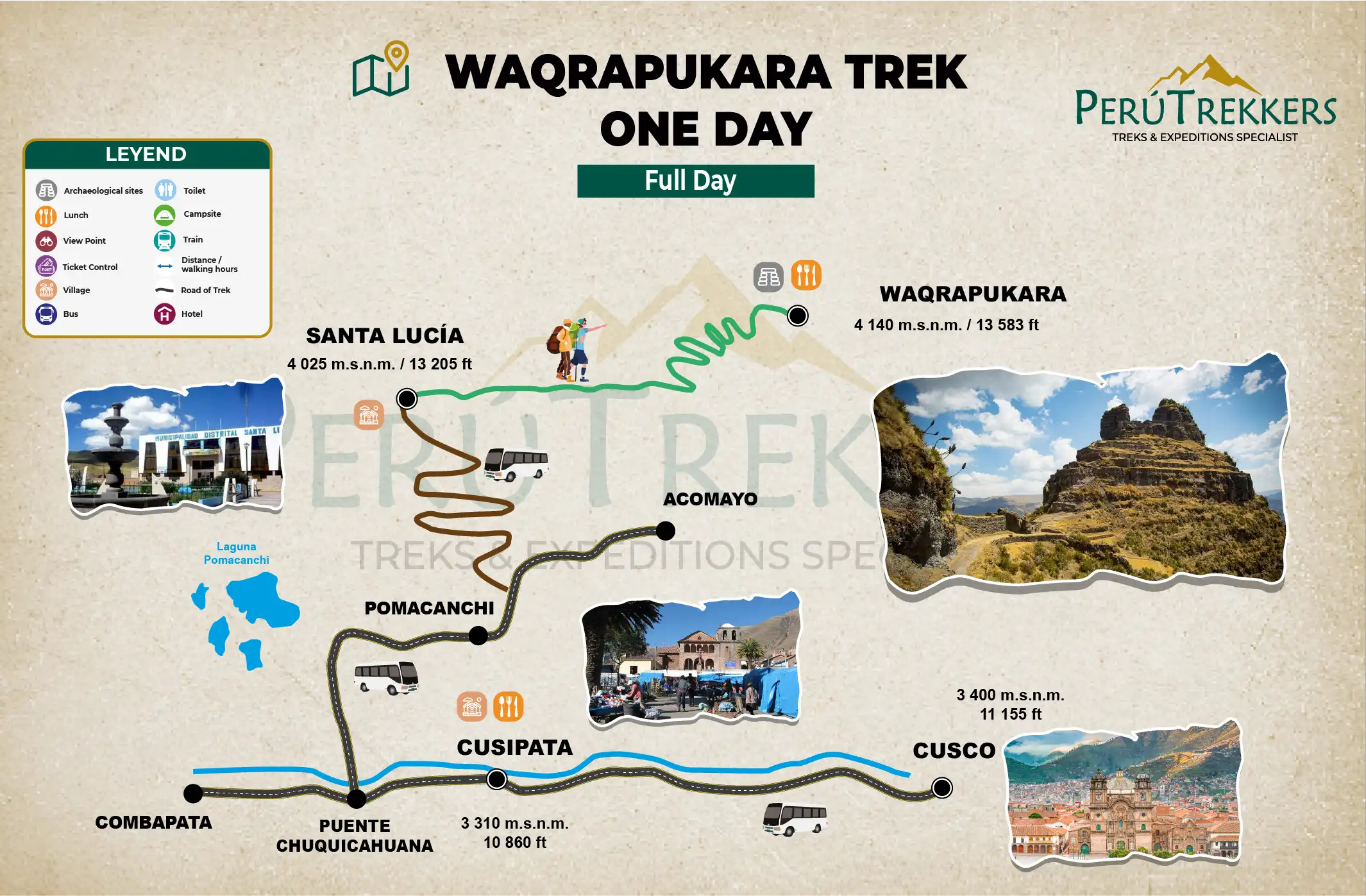
We begin our trek to Waqrapukara by car, leaving Cusco in our private transport at around 4:00 am. We are heading south valley of Cusco on a paved road, in the direction of district called Acomayo. Along the way, we will pass the impressive Pomacanchis lagoon and several picturesque villages until we reach the Huascar junction where the paved road ends, and adventure begins. We continue on a hardened dirt road until we reach Huayqui (also spelled Wayki or Wayqui), the trailhead for our Waqrapukara trek.
Before we begin the hike to Waqrapukara we’ll get to share breakfast with a local family. Then it’s time to set out! The first part of our walk takes us to Suythuwanca, which will take about an hour and a half. From here, we continue walking uphill for another 1h30 along a winding path, bordered by mountains. The views here are out of this world!. In addition to these breathtaking vistas, we will be treated to fascinating ancient rock paintings along the way. Some of these cave paintings are in a great state of preservation.
Finally, we will arrive at Waqrapukara (4300m / 14,107 ft). We’ll rest and enjoy a boxed lunch before starting our guided tour of this mysterious Inca fortress. In Quechua, Waqrapukara actually means “Horn Fortress,” from the words waqra (“horn”) and pukara (“fortress”), and it is a real sight to behold. It is the horn-like rock formations that likely give the Inca fortress its name.
Waqrapukara is an imposing archaeological feature perched on a mountain top, surrounded by gorgeous, lush scenery. We’ll have about an hour to explore this fascinating site. Signs direct us to the different areas of the site, which actually includes several structures.
When we’ve had our fill of Inca history and interesting ruins, we will return along the same path. As we walk another 2hrs to our starting point, we’ll have one last opportunity to take in the stunning beauty of the surrounding mountains.
Finally, we arrive at Paltacancha where our vehicle will be waiting to take us back to Cusco, arriving at about 7pm.
INCLUDED IN THE TREK TO WAQRAPUKARA 1 DAY :
- Boxed breakfast and lunch. Vegetarian, vegan and gluten-free options available
- Private transport from Cusco to Waqrapukara round trip
- English/Quechua/Spanish speaking professional guide, plus an assistant guide for groups over 8
- First aid kit including emergency oxygen bottle
- Entrance ticket to Waqrapukara ruins
NOT INCLUDED
- Additional horses for your personal luggage or to ride
- Trekking Poles
- Tips for the travel staff
- Travel Insurance
WHAT YOU SHOULD BRING TO WAQRAPUKARA TREKKING
For this one-day activity, try to bring the most essential trekking implements, a good feather or nylon jacket that keeps you warm, excellent hiking shoes, gloves, sunglasses, a small backpack, and extra money in soles for your personal expenses. And most importantly, bring the best adventurous spirit, always drawing the best smile for the wonders that the majestic Apurimac canyon gives us.
ALL THE INFORMATION ABOUT THE TREK TO WAQRAPUKARA
The trek to the ruins of Waqrapukara is one of the most spectacular, since only very few people have visited it, and it still maintains the beauty of its natural landscape, with wild flowers, and pure air, where you can breathe calm and magic of the Andes. In this list of questions, our adventurers club answered the most frequently asked questions about this archaeological attraction of Cusco. If you have any other questions, please, you can do it through the online chat, or by mail.
HISTORY OF THE WAQRAPUKARA RUINS
Research indicates that Waqrapukara was initially built by the Canchis culture and not by the Incas. The Canchis inhabited the southern territories of Cusco (current province of Canchis) parallel to the Incas. Both cultures competed for territorial control.
However, after the Inca vs. Chancas (1440 AD), the Canchis allied themselves with the Incas and formed part of the Collasuyo region, in the nascent empire of Tahuantinsuyo.
The construction date of Waqrapukara is still a mystery. The canchis must have built the first roads and enclosures in a few centuries before the formation of the Inca empire in 1438. It is estimated that under the government of Emperor Túpac Yupanqui (1471 – 1493) the main temples and platforms were built.
Oral tradition brought to this day an Inca legend about Waqrapukara. This legend tells that this area lived the nobility of the Inca Qanchi. The legendary General T’ito Qosñipa, with the army of the Inca Wayna Qhapaq, won high awards as general of the conquering armies of the Tawantinsuyo Empire. In use of his vacations he came to his Qanchi tribe, stimulated by the magnificence of the Imperial Court considering distant and remote the possibility of occupying the Inca throne due to his commoner condition, it arose in his audacious mind, to overthrow the ruler of the Inca empire, with For this purpose, he ordered the construction of the Waqrapukara Fortress in secret, so that if his revolutionary adventure failed, he could take refuge and resist any attack by the imperial army.
T’ito Qosñipa proclaimed general of the Qanchis, organized an army, which then headed towards Cusco. The Ruler of the Tawantinsuyo Empire, informed by the subversive activities of T’ito Qosñipa, sent a part of his army to unveil the movement, commanded by General Anqoayllo. Both armies met on the slopes of the Phiñaypampa hill, near Corma. After a bloody and bloody battle, the hosts of T’itto Qosñipa were defeated.
As testimony to this fact, there are still human bone remains at the site of the battle. T’ito Qosñipa the Inca Qanchi, after the battle of Phiñaypampa, with the rest of his soldiers, returned to Waqrapukara. General Anqoayllo’s troops pursued the fugitives and surrounded the Waqrapukara fortress with violent attacks. When the soldiers of the aforementioned general went up to the fortress, they were thrown into the ravine as they went up, through the gates towards the abyss, today there are remains of these gates. After fifteen days of resistance to the imperial Inca army, they discovered the water channel that supplied the fortress, they cut off this water service to the Inca Qanchi’s army, for this reason he had to capitulate with General Anqoayllo.
T’ito Qosñipa was taken prisoner with a hundred of his Qanchi soldiers before the Inca ruler of the Empire. Wayna Qhapaq, knowing the reckless courage of the young warrior T’ito Qosñipa, seeing that he would be useful in his conquests, spared his life and made him marry a ñusta chosen by the Inca Qanchi in Cusco. His soldiers were also amnestied, they returned to their Qanchi tribe, with the promise of being loyal to the empire. But the ears of the hundred Qanchi soldiers were cut off. Since then they have been called mottoqanchis.
In the future, in the conquest of more Inca territories towards Ecuador by Wayna Qhapaq; This warrior T’ito Qosñipa fought with the brave Cañaris. For the triumph of the imperial Inca, two thousand Cañaris warriors of the imperial guard were brought, escorting the victorious Wayna Qhapaq. Some of these brave Cañaris warriors were also taken to the Qanchis tribe by T’ito Qosñipa; For this reason, the surname Cañari also exists today in Pomacanchi.
According to local stories, before their ears were cut off, the Qanchi soldiers of T’ito Qosñipa danced the dance of the Qanchis, by order of the imperial Inca. This dance called Qanchi Tusuy is currently practiced in Cusco, especially by the Qanchis of the 19th century. From that date they bore the nickname of Mot’oqanchis, the soldiers of the Inca Qanchi. But since colonial times, Mot’oqanchi has remained the surname, currently the offspring of such a brave warrior, we find Mottoccanchi in the ayllu of Qanchoqa, District of Pomacanchi.
HOW TO GET TO WAQRAPUKARA?
There are three routes to get to Waqrapukara from the city of Cusco:
- Route through Sangarará: The trip by car starts from Cusco and ends in the town of Sangarará (2 hours 30 minutes trip). Then there is a 15-kilometer walk (between 2 to 3 hours) to Waqrapukara. The return path is the same.
- Route through Huayqui: This route is preferred by tourists and tourism agencies to the peasant community of Huayqui (approximately 3-hour trip). From here begins a walk for approximately 7.5 kilometers. This route on foot takes 1 hour 30 minutes.
- Route through Santa Lucía: This route also follows the route south of Cusco until arriving at the peasant community of Santa Lucía (approximately 3-hour trip). From there begins the 2-hour walk to Waqrapukara. Much of these routes follow Inca trails and ancient pre-Hispanic trails.
WHERE IS THE WAQRAPUKARA ARCHAEOLOGICAL SITE LOCATED
This archaeological complex is located in the district of Pomacanchi, province of Acomayo, department of Cusco. It rises over 4,300 meters above sea level, at the top of a huge ravine covered with forests that crown the abysses that lead to the canyon of the river. of Apurimac.
WHY IS IT NAMED WAQRAPUKARA?
The original name of Waqrapukara is “Llaqtapukara”; it seems that this name was being lost over time in colonial times and the name waqrapukara was given by a group of mestizo intellectuals who plan to recover the archaeological remains and clean up this place, they gave that name because the two natural towers had shape of the horn of a cattle, In the Pre Inca and Inca times there were no cattle, so it is impossible that they have given it the name Waqrapukara. Rather lately the careful observers have found the image of the llama, in truth we can find the image of the head with its respective neck; the two natural towers are the ears of the auquénido and not of a bovine, these characters who visualized the aforementioned image are Mr. Odilón Cruz and Mr. Lucio Delgado Figueroa.
WHAT IS THE WEATHER LIKE ON THE ROAD TO WAQRAPUKARA?
The climate is varied according to the zone, in the part of the Interandean Valley a warm temperate climate is felt that reaches 22° and in the Mountain part a cold and dry climate is felt that reaches 20° and the minimum of -4 ° in the frosty season.


